

NEGROS ORIENTAL. The 6.9-magnitude earthquake that struck Visayas on Monday damaged properties, including these softdrink cases placed along the highway in Guihulngan, Negros Oriental. (Photo courtesy of Dennis Ortega)
แผ่นดินไหว 6.9 ที่เกิดขึั้นที่ Visayas เมื่อวันจันทร์ที่ผ่านมา ทำให้บ้านเรือนพังเสียหาย รวมทั้งขวดน้ำดื่มได้กระจัดกระจายไปตามถนน

CEBU. More than two hours after the 6.9-magnitude quake struck Cebu and Negros, false reports of seawater moving inland sent crowds running from downtown Cebu City to higher ground. (Alex Badayos)
ซีบู - มากกว่า 2 ชั่วโมงหลังจากแผ่นดินไหว 6.9 ที่เกิดขึ้นที่ ซีบู และ Negros รายงานผลของระดับน้ำทะเลยได้เคลื่อนตัวมาในแผ่นดิน ทำให้คนส่วนมากวิ่งจากใจกลางเมืองไปยังที่สูงของแผ่นดิน
http://www.sunstar.com.ph/cebu
Quake toll rising but no deaths in Cebu
- Tuesday, February 7, 2012
CEBU CITY (Updated) -- Local officials expect an increase in the number of fatalities in Monday's earthquake that struck Negros and Cebu islands, with search and retrieval operations ongoing for dozens of people trapped under collapsed buildings and houses.
No major damage and no deaths were reported in Cebu province, but the National Disaster Risk Reduction and Management Council (NDRRMC) recorded at least seven fatalities in neighboring province of Negros Oriental.
Have something to report? Tell us in text, photos or videos.
Reports from the Philippine Army showed 43 people confirmed dead, but this did not yet make it to the official updates of the NDRRMC as of this posting.
ทางหน่วยทหารรายงานว่ามีคนตาย 43 คนแล้ว แต่ยังไม่ได้ได้ประกาศเป็นทางการ
The quake also left 40 people missing, most of them living along the shore near the epicenter of the 6.9-magnitude tremor that struck five kilometers northwest of Tayasan, Negros Oriental.
Philippine Institute of Volcanology and Seismology (Phivolcs) Director Renato Solidum said the quake Monday was set off by movement in an undersea fault.
Eleven other quakes followed the 6.9-magnitude tremor that occurred at 11:49 a.m. Monday; the latest of which occurred at 8:29 p.m. 17 kilometers northwest of Tayasan.
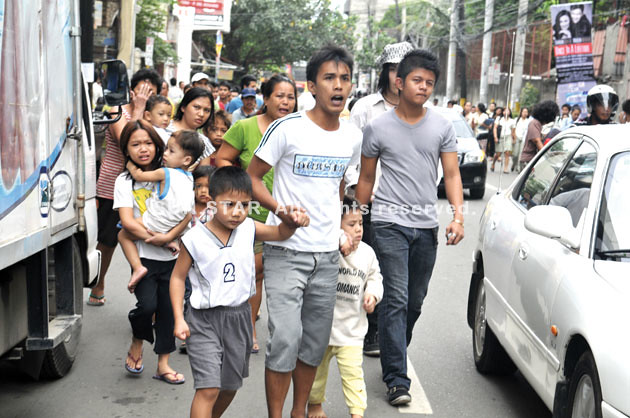 CEBU. More than two hours after the 6.9-magnitude quake struck Cebu and Negros, false reports of seawater moving inland sent crowds running from downtown Cebu City to higher ground. (Alex Badayos/Sun.Star Cebu)
The NDRRMC said one of the fatalities was nine-year-old Bernadette Raidan, who was pinned down by a collapsed wall in Matuog Elementary School in Tayasan town.
Another fatality, 11-year-old Anafe Estrabella, died after she was hit by a collapsed wall in a chapel in Jimalalud. The other victims remain unidentified.
The NDRRMC also reported at least 12 people injured.
President Benigno Aquino III ordered Monday local officials and disaster agencies to validate incident reports, evaluate damage to infrastructure and property, and assist the victims.
Officials in Cebu also ordered buildings checked, especially in schools, to assess how much damage the quake caused.
“That’s the strongest we’ve had so far in Cebu,” said Cebu City Mayor Michael Rama, whose regular press conference the earthquake interrupted.
“There’s more compelling reason now to work together… We can’t be too complacent when it comes to matters concerning the environment… we should accelerate efforts to fix drainage systems and find ways how we can relocate people in the coastal areas. We also have to remove structures under bridges,” he continued.
Initial reports in Cebu City mentioned landslides in Alegria, as well as cracked belfry towers in Badian, Malabuyoc and Boljoon.
In Negros Oriental, local officials said the 6.9-magnitude earthquake wiped out five cottages owned by Comendador Beach Resort in La Libertad town, while 20 houses were damaged.
The Phivolcs said, however, that it remains to be seen if the cottages were swallowed by advancing waters as a result of the earthquake.
Also in the same town, a three-storey Laturnas Building collapsed, but the Philippine National Police is still trying to verify if someone died or got injured due to the incident.
Landslides
In the mountain village of Planas, 9 miles (15 kilometers) from coastal Guihulngan town, also in Negros Oriental, as many as 30 houses were buried with at least 40 residents believed trapped, said Governor Roel Degamo.
"Their situation is bad because if you are covered by landslide for one hour, two hours, how can you breathe?" Mayor Ernesto Reyes said. "But we just hope for the best, that there are still survivors."
Army troops and police were deployed to help in the rescue.

"We're now getting shovels and chain saws to start a rescue because there were people trapped inside. Some of them were yelling for help earlier," Besario told The Associated Press by phone. Three key bridges in the town cracked and were no longer passable, he added.
Food and medicines were waiting in the provincial capital of Dumaguete, but the aid could not reach the villages in need because of damaged roads and bridges.
"There is a Canadian and an Indian doctor who are here for an earlier scheduled medical mission and it's good that they are helping us," said Reyes. "They have some medicines with them but that may not be enough."
Nine bridges were damaged in Negros Oriental, including four that were or not passable, said Governor Degamo. The worst damage was concentrated in the province's mountainous northern portion, he said.
State seismologists recorded over 150 aftershocks hours after the 6.9-magnitude quake hit.
Aside from the damages and fatalities, the quake Monday prompted local officials to suspend classes and government work in Negros Oriental, Iloilo City, and Cebu. Residents Kabankalan City, Negros Occidental, suffered a blackout due to tripped power lines.
Photos courtesy of Dennis Ortega, Mark John Buenconsejo, Khristianie Lauta Cornelio, Fred Baa, Lloyd Anthony Garcia and Iloilo-PIO
Tsunami
In Cebu City, panic enveloped the city due to tsunami scare brought by reports of rising seawater after the 6.9-magnitude earthquake. The streets in downtown Cebu City looked like a scene from some disaster movie, with thousands of panic-stricken people running to safety.
Students and office workers poured out of offices and schools, while vendors abandoned their stalls at the Carbon market to run toward higher grounds.
Some people chose to go up tall or even mid-rise buildings, while others fled toward Fuente Osmeña and the Capitol.
In their panic, some people left their vehicles on the road to join the crowd that filled the streets while others ran to their homes to grab their children and nothing else, only to hit the streets again.
The panic erupted after some people heard rumors that a tsunami hit the coastal barangays of Pasil, Ermita and Mambaling.
Sun.Star traced the reports on the rise of seawater in the coastal village of Ermita in Cebu City, but Alejandro Galledo of Barangay Ermita said seawaters rose after a fast-craft passed by the area.
Robinson Jorgio of Phivolcs-Central Visayas said over radio that a tsunami normally occurs three or seven minutes after a tremor, and not much later.
He said people should not panic during earthquakes so that they will continue to be rational.
Phivolcs issued a "level 2" tsunami alert, which advises the public to be "on alert for unusual waves" and for residents in the coastal areas of Negros and Cebu to "be watchful." Phivolcs, in live radio interviews, said there was no advice to evacuate.
The alert was cancelled at 2:30 p.m. after the threat of one-meter waves has dissipated.
"There is no more threat of unusual waves. There was no evacuation at alert level 2 and what was advised was for people to stay away from the shoreline and for people with houses near the coast to be watchful," Solidum told Sun.Star.
He said, however, that weaker quakes are expected to continue until next week.
Still, classes in most schools were suspended by 1 p.m. and Cebu City Hall sent home employees shortly after the first earthquake struck. Other government offices and private firms, including those in Iloilo City, did the same.
Following the lifting of tsunami alert, Philippine Coast Guard (PCG) commandant Vice Admiral Edmund Tan directed his units to allow any ships and other water crafts to sail or to venture out to sea after the tsunami alert was lifted.
"However, PCG search and rescue units and deployable response groups in the respective units are still on full alert for possible deployment in case of another strong earthquake," Coast Guard public affairs chief Lieutenant Commander Algier Ricafrente said in a text message.
Department of Health (DOH) Secretary Enrique Ona also directed the agency's field health units from the affected provinces to quickly respond to the situation.
Ona advised the public to ensure safety by staying away from structures that have been damaged or compromised due to the magnitude of the quake and to seek immediate medical attention for injuries.
For its part, the Department of Social Welfare and Development (DSWD) said quick response teams have been alerted to assist local government units in assessing the impact of Monday's shaking.
"Rest assured that concerned DSWD regional offices have enough standby funds and supplies, ready for distribution to affected local government units," Social Welfare Secretary Corazon "Dinky" Soliman said.
The Philippines sits on the "Pacific Ring of Fire" where continental plates meet, causing frequent seismic and volcanic activity. About 20 earthquakes hit the country everyday but only a few are felt.
In Cebu, Monday’s quake was the strongest this year, based on Phivolcs’ earthquake bulletins.
A 5.9 magnitude quake was recorded near Eastern Samar on January 17, while another 5.9 temblor was recorded on February 4 near San Policarpio, also in Eastern Samar.
In Negros, the strongest to hit the island was the 8.2-magnitude quake in 1948, but it did not cause additional massive damage because the region was still reeling from the devastation of World War II, the Phivolcs said. (Virgil Lopez/AP/With Sun.Star Cebu/Sunnex)
http://www.sunstar.com.ph/cebu/local-news/2012/02/07/quake-toll-rising-no-deaths-cebu-204718
Rumors of a tsunami hitting downtown Cebu City caused people to panic
By Bernadette A. Parco, Davinci S. Maru, Kevin A. Lagunda and Linette C. Ramos
Tuesday, February 7, 2012
FOR several minutes yesterday afternoon, the streets in downtown Cebu City looked like a scene from some disaster movie, with thousands of panic-stricken people running to safety.
At past 2:30 p.m., shortly after Phivolcs lifted the “tsunami alert level 2” status in Cebu, panic and hysteria broke out in downtown Cebu City.
Have something to report? Tell us in text, photos or videos.
Students and office workers poured out of offices and schools, while vendors abandoned their stalls at the Carbon market to run toward higher grounds.
Some people chose to go up tall or even mid-rise buildings, while others fled toward Fuente Osmeña and the Capitol.
In their panic, some people left their vehicles on the road to join the crowd that filled the streets while others ran to their homes to grab their children and nothing else, only to hit the streets again.
The panic erupted after some people heard rumors that a tsunami hit the coastal barangays of Pasil, Ermita and Mambaling.
Five vehicular accidents occurred, according to the Cebu City Traffic Operations and Management (Citom).
Minutes
Robinson Jorgio of Philippine Institute of Volcanology and Seismology (Phivolcs) 7 said over radio dySS that a tsunami normally occurs three or seven minutes after a tremor, and not much later.
He said people should not panic and during earthquakes so that they will continue to be rational.
Joel Lee, Movement for a Livable Cebu co-convenor, pointed out the need for a centralized source of information, especially during disasters.
"Text messaging has proved once more to be a very swift way to disseminate information. But in the absence of official announcements, misinformation could cause panic and put people in unnecessary danger,” he said in a statement.
Residents were in a state of anxiety after a 6.9 magnitude earthquake occurred in Negros at 11:49 a.m. The tremor was felt in Cebu and other parts of the Visayas and Mindanao.
No evacuation
Phivolcs issued a “level 2” tsunami alert, which advises the public to be “on alert for unusual waves” and for residents in the coastal areas of Negros and Cebu to “be watchful.”
Phivolcs, in live radio interviews, said there was no advice to evacuate.
Still, classes in most schools were suspended by 1 p.m. and City Hall sent home employees shortly after the first earthquake struck. Other government offices and private firms did the same.
Cebu City Police Office Director Melvin Ramon Buenafe said building owners should have their properties inspected for cracks that may affect the stability of the buildings.
Electrical connections must also be checked to prevent fire.
Amid talks of aftershocks and a tsunami, Citom recorded road accidents in Barangay
Mambaling, Gen. Maxilom Ave., M.J. Cuenco Ave., C. Padilla St. in Barangay Duljo-Fatima and at the South Road Properties, all in Cebu City.
Traffic
Citom Executive Director Rafael Yap said there were no fatalities.
The panic caused by fear of a tsunami resulted in heavy traffic on Colon St., Carbon area, Osmeña Blvd., P. del Rosario St., V. Rama Ave., Gov. Cuenco Ave., Banilad and the areas outside SM City Cebu.
Alvin Santillana, executive director of Cebu City’s Local Disaster Risk Reduction and Management Council, said the panic started when residents in coastal barangays cried “tsunami” and spread word that the water level is rising.
A resident in Barangay Sto. Niño said he heard people saying that Colon St. was already flooded.
Most people did not have radios so they could not get updates on the earthquake and the tsunami alert.
There were some who said a man, riding a motorcycle on Gorordo Ave., was telling people he passed by that the sea has flooded downtown Cebu City.
Criticisms
Even if the tsunami alert was lifted, Santillana said the public should remain vigilant for any aftershock.
In social networking sites, government authorities were criticized for their failure to provide the public with accurate information on the tsunami alert and advisory on what people should do.
Santillana said telecommunication networks were down since yesterday noon, so they had to rely on traffic enforcers, policemen, firemen and barangay officials who were asked to go around the streets to correct false information on a tsunami so people would calm down.
But with the hundreds of people rushing to get out of the downtown area, the limited number of enforcers and policemen failed to appease the public right away.
At the Cebu City Medical Center, patients reportedly removed their intravenous tubes and ran outside the hospital, fearing the building would collapse.
Unfazed
Lee said he used the public announcement system of West Gorordo Hotel on Gorordo Ave., Cebu City to tell people to calm down.
In Oslob town, whale shark watchers were unfazed, said PO2 Alan Villasurda in a phone interview.
After they were informed about the tsunami warning, the police advised fishermen to stop feeding the sharks and told the tourists to go home around 1 p.m.
In Alcoy town, PO2 Raniel Cartin said in a phone interview that residents saw big waves but these were not big enough to go past the seawall.
Published in the Sun.Star Cebu newspaper on February 07, 2012.
http://www.sunstar.com.ph/cebu/local-news/2012/02/07/rumors-tsunami-hitting-downtown-cebu-city-caused-people-panic-204711

